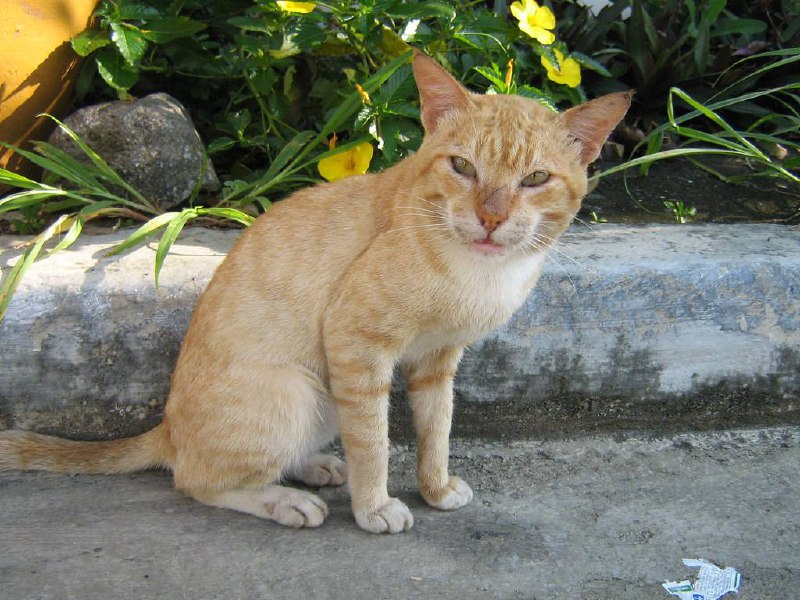
DEERFIELD BEACH, Fla. — The cat showed up sometime in the spring of 2024. No collar, no microchip, no apparent interest in being held. It was an orange and white tabby, on the smaller side, with a notched left ear that suggested it had been through a trap-neuter-return program at some point. Where it came from, nobody on the block could say. One morning it was just there, sitting on the warm concrete of Gloria Medina's front steps, watching traffic pass on SE 2nd Avenue.
It never left.
For nearly two years, the cat made a home out of a single residential block in this quiet stretch of southern Broward County, between East Hillsboro Boulevard and SE 15th Street. It slept under cars, on porches, in the shallow mulch beds around the base of the coconut palms that line the sidewalk. It ate well. Medina, a retired school bus driver, kept a ceramic bowl by her curb. Two doors down, the Esperanza family left dry food on their patio each evening. Roberto Vega, a 64-year-old retired mechanic who has lived on the block for 18 years, gave it canned tuna on occasion, though he insisted he wasn't the sentimental type.
"I'm not a cat person," Vega said on Monday, standing in his front yard with his arms crossed. "But the thing would come sit next to me while I was working on the lawn mower. What am I going to do, tell it to leave?"
The cat had no name that anyone agreed on. Medina called it Sunny. The Esperanza kids called it Señor Whiskers. The man who runs a small engine repair shop on the corner, who asked not to be identified by name, called it Gato and left sardines out for it on Friday evenings. At least three households kept water bowls topped off in their driveways. A woman at the end of the block had bought a flea collar for it last summer and managed to get it around the cat's neck while it was drowsy in the afternoon heat. It wore the collar for about four days before losing it somewhere.
Nobody owned the cat. But a dozen people on a single block had, without organizing or even discussing it much, built a distributed life-support system around it.
On Saturday morning, at approximately 7:15 a.m., Medina went outside to fill the ceramic bowl as she does every morning. She found the cat lying motionless beneath the large coconut palm at the edge of her property line. A mature coconut, still partially green and weighing what a Broward County animal control officer would later estimate at roughly three pounds, lay on the sidewalk next to the animal. There was blood on the concrete.
"At first I thought he was sleeping, because that's where he always was in the morning, right under that tree," Medina said. "He liked the shade there. Then I saw the coconut and I just — I knew right away."
Medina called Broward County Animal Care and Adoption. An officer arrived within the hour, confirmed the cat was dead, and collected the remains. The agency classified the death as accidental. No further action was taken. The officer, according to Medina, was polite about it. He said it wasn't the first time he'd responded to something like this.
Falling coconuts are a well-documented hazard in South Florida, though the victims are almost always cars, roofs, or the occasional pedestrian. A mature coconut palm of the Malayan Dwarf variety — the cultivar most commonly planted along residential streets in Broward County — can produce between 50 and 200 coconuts per year. The fruit can weigh up to four pounds, and from the crown of a 40-foot tree reaches a velocity of roughly 50 miles per hour before impact. A University of Florida agricultural extension bulletin from 2019 compared the force to being hit by a bowling ball dropped from a second-story window.
Dr. Lisa Ormond, director of community cat programs at the Broward County Humane Society, said that while outdoor cats face a wide range of environmental hazards — vehicles, predators, extreme heat, toxic plants — deaths from falling debris are rarely documented with this level of specificity.
"Community cats live in a world of risks that house cats never encounter," Ormond said. "Coconuts, falling branches, storm debris — it's part of the reality of an outdoor life. What's unusual here is that so many people were paying attention to this particular animal. Most of the time, a stray cat dies and nobody notices."
The Broward County Humane Society estimates there are approximately 400,000 free-roaming cats in Broward County alone — a population sustained by a mix of breeding, abandonment, and the region's year-round mild climate, which allows cats to survive outdoors in ways they cannot in colder parts of the country. Most are invisible to the people who live near them. They exist in the margins: under dumpsters, in drainage culverts, beneath parked boats in side yards.
The cat on SE 2nd Avenue was not invisible. It was, by all accounts, a fixture.
"He had a whole route. He'd start the morning on Gloria's steps, then he'd go sit on the Esperanzas' porch around ten, then over to my driveway by lunch. You could set your watch by that cat."
That was Vega, who said the cat had a particular fondness for sitting on the warm hood of his 2003 Ford F-150 in the late afternoon. He said he would sometimes find paw prints on the windshield in the morning and that he had stopped washing the truck partly because he knew the prints would be back the next day.
"My wife thought I was losing it," Vega said. "She'd say, 'Why don't you wash the truck?' and I'd say, 'Why bother?'"
Diana Esperanza, 38, whose children had named the cat Señor Whiskers and would argue about whether it was a boy or a girl — it was male, according to the animal control officer — said the loss had hit her kids harder than she expected.
"My daughter is nine," Esperanza said. "She came home from her friend's house on Saturday and asked where the cat was. I had to tell her. She didn't really understand how a coconut could kill something. I didn't really know how to explain it either, honestly."
Esperanza said her daughter made a card that evening — construction paper folded in half, with a drawing of an orange cat next to a palm tree and the words "FLY HIGH SEÑOR WHISKERS" written in purple marker — and asked to bring it to the tree. It is now part of a small memorial that has accumulated at the base of the palm over the past week.
The memorial, as of Thursday, includes the construction paper card sealed in a plastic bag to protect it from the rain, a ceramic bowl painted with fish — the same one Medina had used for feeding — a votive candle in a glass holder, a laminated photograph apparently taken on a phone of the cat sitting on a concrete step with its eyes half-closed, and a handwritten note on a piece of cardboard that reads: "We miss you Gato."
The note was written by the man from the engine repair shop. He asked not to be quoted.
Medina said she has received messages from other people in the neighborhood — some of them on blocks she didn't realize the cat had been visiting — who said they had also been feeding it.
"A woman from the next street over came by on Sunday," Medina said. "She said the cat had been coming to her back door every Wednesday. Wednesday! Like it had appointments. She was crying. I'd never met her before. We just stood in my driveway and cried together about this cat that neither of us owned."
Dr. John Bradshaw, a visiting fellow at the University of Bristol's School of Veterinary Sciences and the author of "Cat Sense: How the New Feline Science Can Make You a Better Friend to Your Pet," said the intensity of the community's reaction, while it may seem disproportionate to outsiders, is entirely consistent with how humans form bonds with animals they encounter regularly.
"You don't have to own a cat to grieve for it," Bradshaw said in a phone interview. "Attachment in humans is driven by familiarity and routine. If you see an animal every day, if you feed it, if it sits near you — you've entered into a relationship, whether you intended to or not. The label on that relationship, whether it's 'pet' or 'stray' or 'community cat,' doesn't change the emotional weight of the loss."
Bradshaw said community cats occupy a unique emotional space for the people who interact with them, in part because the relationship is voluntary on both sides.
"A house cat is there because you brought it home," Bradshaw said. "A community cat is there because it chose to be. There's something about that — the fact that it came to your door, that it selected your porch — that can feel more meaningful than ownership. It's a kind of trust."
Vega said he hadn't expected to feel much about the death. He repeated, twice, that he is not a cat person. But he admitted that his mornings have felt different in the past week.
"I go out to work on something in the yard and I look over at the spot where he used to sit, next to the truck, and he's not there," Vega said. "It's a small thing. But it's there every morning."
He paused.
"Sixty-four years old, getting emotional about a cat I never even named," he said. "Don't put that in the paper."
As of Thursday afternoon, Medina's ceramic food bowl was still sitting on the curb at the edge of her property, in the same spot it had occupied for nearly two years. It was empty. She said she hasn't been able to bring herself to move it.
"I keep thinking maybe another one will show up," she said. "That's how the first one came, right? He just showed up. Maybe another one will."
She looked across the street at the palm tree, where the laminated photograph of the cat fluttered slightly in the breeze.
"Maybe another one will," she said again, quieter this time, like she was trying to convince herself.
Michael Reyes reported from Deerfield Beach, Florida.